




Slowe admits
brutality, corruption in police force
Promises 'new dispensation'
By Samantha AlleyneSunday, May 23, 2004
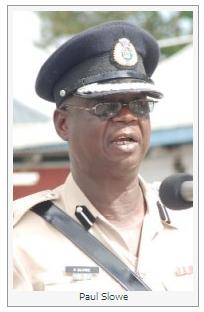
New Commander of `A' Divi-sion, Assistant Commissioner Paul Slowe says he is
no proverbial ostrich burying his head in the sand. He readily admits there is
evidence of police brutality and corruption in the force and that those ranks
should be identified and dealt with.
However, this cannot be done without the help of the public who would need to
provide the information about any wrongdoing.
Slowe was recently transferred from `B' Division, Berbice and is seen as a
no-nonsense officer even though controversy has surrounded him of late. Late
last year he moved to the High Court and got an injunction against former
acting Commissioner of Police, Floyd McDonald, preventing him from him being
transferred from Berbice following his refusal to apologise to Home Affairs
Minister Ronald Gajraj.
But this spat has not hurt his career given he has now been appointed the
commander of the country's busiest division. Despite huge challenges, he does
not have any special plans for the execution of his job: "I have my
approach, which might be different from the approach others might have taken,
but my approach is very straightforward. I think it is well established and
known by now."
And were more to follow his example he says the work would become much easier,
simply because it is based on the principle that all ranks are there to serve
to the public.
Slowe, who has a degree and a diploma from the University of Guyana and
countless certificates from overseas training, is now responsible for all
aspects of the division including, crime, traffic and general duties.
"When you talk about crime I intend to ensure that we are proactive, have
our patrols and... try to gather intelligence so that we can embark on more
intelligence-led activities, not just running here and there wildly..."
He says the force has limited resources and as such, members are forced to
work within certain limits.
"Once you have limited resources then you have to utilise them very
carefully and that is why I intend to ensure that we try to gather
intelligence, so that when we have exercises and we have operations they are
based on intelligence."
He recalls that Commissioner of Police Winston Felix had stated at the
recently concluded officers' conference that the force would be working on
re-establishing the beat system. Slowe says the system has been resuscitated
and they intend to ensure that it is maintained since it is a proactive
measure with a presence on the road.
"We don't have as many as we would wish to have in the long run, but for
now we've identified certain areas and we have ranks in these areas."
As for traffic, Slowe says the East Bank and the areas around the minibus
parks continue to be very problematic. There have been several accidents on
the East Bank with two fatalities just last week.
Weed-out bent cops
As to what can be done to change the public's perception of the force, he
suggests that there is need to identify those persons who tend to be
unprofessional and "weed them out."
"...It is one of the things that I am targeting to ensure that those
persons are identified; those persons who treat people in any rude way so they
could be dealt with. We have a mechanism in the force to deal with those
persons..."
He intends to have ranks trained on how they should deal with the public and
this has already commenced.
"If after that [the training] they continue, we have to take drastic
measures to weed them out of the system." It is all part of a "new
dispensation" as he puts it.
"But I want to say this at this point we need the support of the public
to deal with it because when these people are rude and unprofessional they are
not unprofessional to me the commander, they are rude and unprofessional to
the public and they must be prepared to make complaints so that we can deal
with [these persons].
"I have said on several occasions that you might not have confidence in a
particular policeman, but I am sure in a small country like ours there must be
people who you have confidence in. Whether they are inside or outside, whether
they are a priest or a teacher, go to them and they in turn must know someone
that they can trust and eventually you are going to get to the right
person..."
CSI techniques needed here
Slowe does not think the force lacks investigative skills: "What I know
that we lack are some of the modern investigative tools, and that is what in
most cases prevents us from going further in these investigations."
He comments that numerous persons look at the television investigative
programmes such as CSI (Crime Scene Investigation) and Cold Case and they then
compare what they see to what is happening locally.
He points out that many officers have been trained in crime scene management
overseas and they know what is required, but they do not have tools such as
DNA testing and forensic equipment. "So we have to operate within our
resource limitations. And let me tell you this, I have had persons who operate
in other forces with all of this modern equipment to come and see how we
operate and they are amazed at the kind of successes we have, given the
limited resources."
Questioned about numerous complaints by accused persons of being beaten by
members of the force to give caution statements, Slowe says that while he is
aware that it happens sometimes, in many cases persons are just told to make
such allegations.
"Let me say this, and here I am being brutally frank. I know, having
served in Berbice for over four years and in 'A' Division before, it has
become fashionable now for all the attorneys once they go to court... they
always say that their clients were forced into making the statement. I am not
saying in some cases that ranks have not done the wrong thing, but I am saying
not in all cases as they would want to create the impression that the only
thing the police do is beat people to get caution statements. It is not so, it
is a wrong perception, it is wrong. It is wrong in the sense that we ought not
to do that and it is wrong in the sense that the impression should not be
created."
He says he has firsthand experience where lawyers advised accused persons to
inform the magistrates that the police had beaten them even in cases where the
lawyers do not officially represent them.
He says only a small percentage of persons could say that they had firsthand
experience of such treatment, adding that there was a case where a man went on
a popular television programme with injuries and when the matter was
investigated, it was learnt that he had actually inflicted his own injuries.
However, Slowe says, "I would never say that brutality does not take
place, we are doing our best to address it. I would never ever tell anyone
that corruption does not take place because I have had cases to deal with
ranks who I was convinced were corrupt. I would never, ever be the proverbial
ostrich. I am honest about these things when they exist, but all I am saying
is don't just talk about it, assist us to deal with it. Some people would talk
but then they would say they don't want to come forward, well if you don't
want to come forward then don't talk!"
'I am a bit stubborn'
Not too keen to dwell on last year's spat with Gajraj, Slowe reveals that he
has since withdrawn the matter from the High Court following the swearing in
of the new commissioner.
"I discontinued the proceedings earlier this year; I was not affected in
the least by the issue. People who know me know that is the way I operate,
very professionally, and some will claim that I am a bit stubborn. And maybe
it is so but if I know I am doing the right thing and I am in the right I will
continue to do the right thing."
Slowe says his job is always interesting and if he had to choose all over
again, he would still choose to be a police officer.
He says it is a noble profession and sometimes he is horrified at the
behaviour of some of the junior ranks and how they tarnish the force's image.
It appears they are in for a big surprise with Slowe back in town.