Minister of Home Affairs Ronald
Gajraj has been cleared
of any
involvement in extra-judicial killings
after an investigating commission unanimously
concluded that there was no credible evidence to
corroborate allegations that were made against him
last year.
But his decision to approve several gun
licences, including to Axel Williams, was
criticised for having disregarded the law.
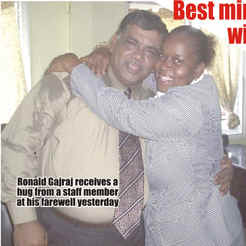
Terminator,
former Minister of Home
Affairs Ronald Gajraj, who is now Guyana's
Ambassador to India
"The basic finding was that there was no
evidence of a credible nature..."
Presidential Commission Chairman Ian Chang said
yesterday, shortly after he handed over the
three-man panel's report to President Bharrat
Jagdeo at the Office of the President (OP).
His disclosure ended weeks of speculation about
the findings of the commission, which examined
several killings that occurred in the last three
years but found no evidence to suggest the
minister's involvement.
Gajraj has been on leave for almost a year to
facilitate the inquiry and yesterday's findings
pave the way for him to resume his duties after
facing serious allegations made last January by
self-confessed informant George Bacchus.
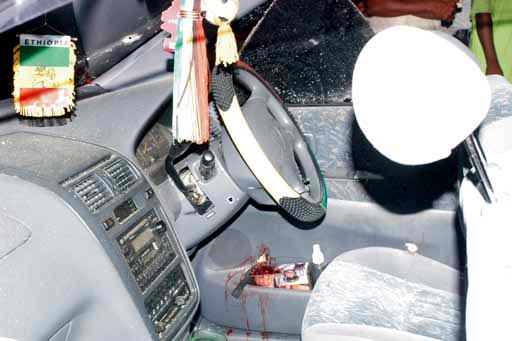
Axel
Williams gunned down - Guyana
Chronicle
Reliable sources told Stabroek News yesterday
that the commission found that Gajraj's close
relationship with suspected
hitman Axel Williams, which was as
a result of his attempts at intelligence gathering
for the police force, led to the perception of his
involvement
in criminal activities. As a result, the
commission is said to have recommended that no
Home Affairs Minister should be personally
involved in activities that are solely within the
ambit of the police force, like intelligence
gathering.
Appellate Justice Chang, ex-Army Chief-of-Staff
Norman McLean and former Chancellor Keith Massiah
made up the commission, which was set up to
determine whether there was any credible evidence
of the minister's involvement in any activities
that involved
unlawful extra-judicial killings.
But no one came forward with evidence and the
commission was forced to subpoena over 20
witnesses who eventually appeared during the
almost six months of public hearings. Chang said
he had hoped more people would have come forward
with evidence but he noted that the testimony of
those persons who turned up was accepted. Chang
and McLean officially presented the report, while
Massiah, expected to attend, was absent.
Chang, speaking with reporters at the OP after
the handing over, said the commission's conclusion
in relation to the allegations against the
minister was unanimous but he admitted that there
was a dissenting opinion by Massiah on some
subsidiary points, although he did not go into
details. He said the argument was included in a
minority report that was written by Massiah.
Axel
Williams and gun licences
The consensus report, which was signed by
Massiah, was said to examine the minister's
approval of several gun licences and found that he
did not always follow the procedure set out in the
law. This included the cases of Williams, Ashton
King and Debra Douglas, where the standard
security checks were not adhered to. Former police
commissioner Floyd McDonald was also said to have
come in for criticism for being a willing party to
the minister's approvals.
The report also points to the fact that after
the minister approved Williams' gun licence their
relationship developed and the taxi-driver became
an informant. Gajraj, during his testimony before
the commission, had said Williams was an informant
who provided him with intelligence about criminal
activities. Their close relationship was found to
have influenced the minister's later decision to
upgrade Williams's .32-calibre gun to a 9 mm
calibre weapon, despite the fact that the man had
shot food vendor Rodwell Ogle over $20 less than a
year before.
Stabroek News was informed that Massiah's
dissenting report is critical of the minister's
approval of the gun upgrade for Williams, since no
valid reason was given for it.
Massiah's minority report was said to also
question the legality of all the minister's gun
licence approvals since he was not authorised to
do so under the law.
Gajraj had told the commission that he had
encountered the present system when he assumed
office.
The consensus report contains several
recommendations for amendments to the Firearms Act
as a result of the evidence that was brought
before the panel, making reference to proposals
that were made over a year ago by the Disciplined
Forces Commission.
Stabroek News understands that the
commissioners agreed on their conclusion on the
allegations because none of the witnesses who
appeared before them implicated the minister in
any killings. Also, the evidence presented was
considered to be of a hearsay nature, without any
corroboration and therefore inadmissible by legal
standards.
Bacchus had said the minister was responsible
for the control of a group of men who hunted down
criminals for execution during the 2002-2003 crime
wave. He claimed to be an informant for the group,
which was reportedly led by the late Williams, and
telephone records would link the man to Gajraj.
Bacchus was murdered last June, a little over a
month after the commission was set up, leaving
only two affidavits containing his allegations
against the minister.
Among these was the claim that he had been
present at the minister's home when the order was
given for the killing of several men: "One
night, I was with [Gajraj] in his home office when
Axel Williams called him and told him, 'Suspects
identified,' and he replied by saying,
'Destroy.'" Bacchus said he later learnt that
night that six men were killed near the junction
of Robb and Light streets.
"I knew then that it was the same killing
that [the minister] had ordered when I was in his
office," he added in the affidavit.
But Stabroek News was told that the telephone
records which the commission subpoenaed from the
GT&T did not support Bacchus' claims about
events that night, as there was no call made to
the minister from any telephone owned by Williams
on that day.
Karen Morris' testimony was another critical
piece of evidence led before the commission. She
is the wife of Lloyd Hazel, a man who survived two
attempts on his life in January and August 2003.
Following one of the incidents, she received a
call from someone who informed her that the
minister was involved in the attempts on her
husband's life, in addition to listing persons who
allegedly made the attempts.
But the commission felt the evidence suggested
that there were several persons, with personal
motives, who could have been behind the attempts
on the man's life.
Before the handing-over ceremony, Information
Liaison to the President, Robert Persaud, told
reporters the report would be made public early
next week, after the President and the Cabinet
would have examined it.
President Jagdeo, in a brief statement, thanked
the commissioners for their work, noting that it
was done in a difficult environment since the
issue was politically charged.
Jagdeo had been widely criticized for his
decision to unilaterally appoint the commission
and yesterday he reiterated what he considered to
be the vital point - that the commissioners were
all persons of integrity.
"I hope at this stage people don't say
they never had a chance to present whatever
evidence they had," he declared, while
commending the commissioners for the openness of
their procedures.